
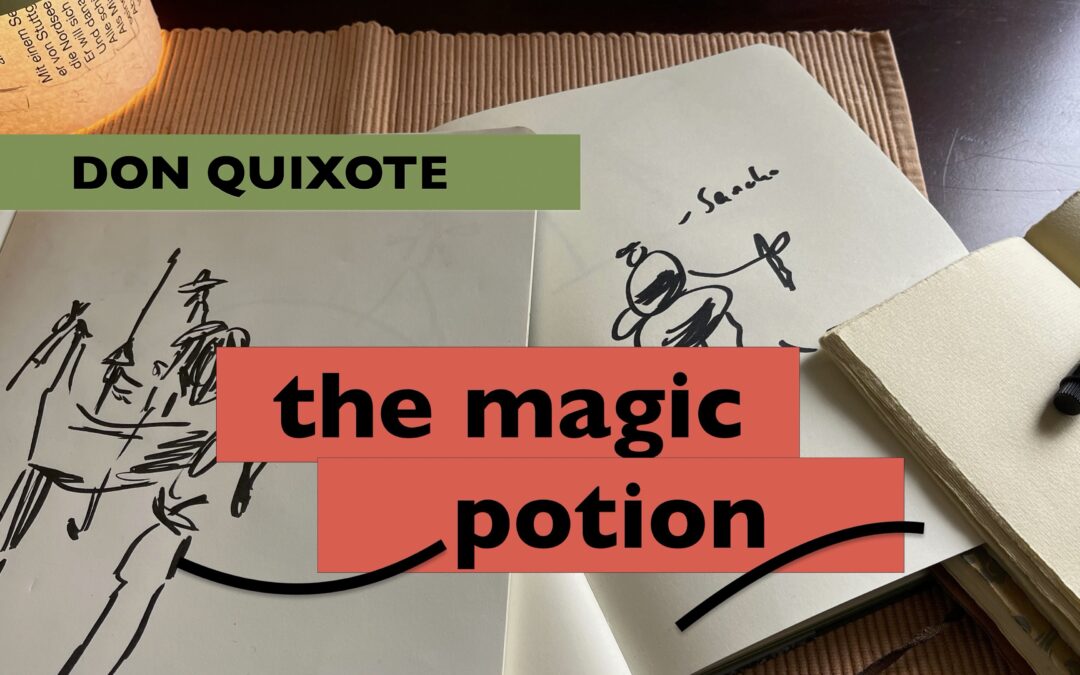
How Don Quixote Makes the World Bigger
What do you do when your besties and homies click into your video — and then click straight back out?
How do you keep them on board?
It is a little like a knight riding along on horseback with his squire beside him, when the squire suddenly thinks: *Actually, I might just go home.*
So what do you do?
Imagination is a good start.
And something that goes rather well with imagination is magic.
Our knight, of course, is Don Quixote. His squire is Sancho Panza. And Don Quixote has developed a method that sits somewhere between imagination, magic and seduction.
Let us have a look.
We meet them just after a fight. Don Quixote is wounded and bleeding, and Sancho is trying to persuade him to tend to his injuries.
Don Quixote, however, has other ideas.
He first asks Sancho whether he has ever seen a more valiant knight anywhere in the world:
> “Have you ever seen a more valiant knight than I anywhere on the face of the earth? Have you read of another who has more spirit in attacking, more courage in persevering, more dexterity in wounding or skill in unhorsing?”
Sancho’s answer is wonderful:
> “The truth is,” answered Sancho, “that I never read any history, because I don’t know how to read or write, but I will say in all my life I never served a bolder master than your grace…”
Sancho cannot read or write. It is an interesting little detail. Don Quixote, meanwhile, has read far too much — enough to sell his property and turn his life upside down.
You might expect this difference to create distance between them.
Instead, somehow, it draws them together.
Sancho’s answer is also quite funny. Don Quixote has asked for a universal comparison: *Am I the greatest knight who ever lived?*
And Sancho’s evidence is essentially:
*Well, I’ve only ever had one master.*
Sample size: one.
But there is loyalty in it, too.
And then Don Quixote tells him about a magic potion.
Sancho is still trying to deal with the blood pouring from his master’s ear:
> “…what I beg of your worship is that we treat your wounds, for a great deal of blood flows from that ear…”
Don Quixote replies:
> “None of that would be needed,” said Don Quixote, “if I had remembered to prepare a flask of the tincture of Fierabras, for just one drop saves time and medicine.”
“What flask is that?” asks Sancho.
And there it is.
Don Quixote has thrown an imaginative ball into the air.
Sancho catches it.
The potion, Don Quixote explains, can save you from practically any wound. Even being cut clean in half is no problem. You simply take the part that has fallen to the ground, fit it carefully back onto the part still sitting in the saddle, give Don Quixote two mouthfuls of the magic potion — and he will be “sounder than an apple.”
It is so extravagant that, when I first read it, I almost thought: *Is this a comic? A cartoon?*
But no.
This is more than four hundred years old.
And there is something beautiful happening here.
Don Quixote is effectively saying to Sancho:
*Come into my world.*
My world is a playground.
We are going to have fun here.
And Sancho does come in.
He immediately starts thinking about the commercial possibilities of the magic potion:
> “If that is true,” said Panza, “I renounce here and now the government of the promised island, and want nothing more in payment for my good services, but that your grace give me the recipe for that supreme liquor…”
But Sancho has another question.
How much does it cost to make?
I love that.
He is naive because he believes the story. But he is also practical. There is always a little businessman sitting inside Sancho.
Don Quixote tells him it is cheap.
Sancho is delighted.
Why don’t they make it immediately?
And then Don Quixote says:
> “Easy now, my friend. I have far greater secrets to teach you and even greater rewards to grant you.”
And that is the sentence that stays with me.
Because, of course, what exactly are these secrets?
Does Don Quixote actually possess them?
Probably not.
Does Sancho still want to hear them?
Absolutely.
Why?
Because Don Quixote never stops making the world larger.
There is always another story. Another promise. Another impossible cure. Another adventure just around the corner.
And perhaps that is his real power.
It isn’t the magic potion.
The potion doesn’t even work.
Later, Sancho tries it and ends up vomiting and feeling as if he is dying. The expectation collapses completely.
No problem.
Don Quixote simply finds another story.
That is the interesting part.
The magic is not that the magic works.
The magic is that there is always another possibility.
And I think that is why Sancho keeps walking.
Don Quixote has a kind of gravity.
He is not simply a dreamer who talks. He acts. He charges into battles. He rides towards giants — even when the giants turn out to be windmills. He puts himself in danger because he believes what he is doing.
That matters.
It means this isn’t simply deception.
Don Quixote believes his own stories.
And his belief is backed up by action.
There is something strangely attractive about that.
I can recognise both sides of this relationship.
I like being the teacher — having something to show, something to tell, something that might be useful to somebody else.
But I also like being Sancho.
I like having something to learn.
In fact, perhaps that is part of why I make videos at all. I watch something, discover something, and then want to turn around and say:
*Come and have a look at this.*
There is a funny little relationship between teacher and learner there. YouTube can become another road on which the two of them travel together.
And while I was making the video, I started imagining what Don Quixote and Sancho might have said to each other before they set off.
Perhaps Don Quixote said:
*I want to become a famous knight. So I am going to allow myself to re-craft reality. If other people think I’m mad, that’s the price I pay.*
And perhaps Sancho replied:
*And I want to become rich. So I’ll do a little reality-recrafting of my own. If people think I’m gullible or stupid, that’s the price I pay.*
They have something important in common.
Both of them reject ordinary, everyday reality.
And then something even more interesting happens: they become dependent on each other.
The knight needs the squire.
The peasant needs the knight — or at least the promise of the island he is going to receive one day.
And somewhere between the promises, the misunderstandings and the impossible adventures, friendship begins to grow.
Which brings me, finally, to what I think may be one of the deepest qualities of *Don Quixote*.
Hospitality.
This book welcomes me back.
It keeps me guessing. It keeps me on my toes. It makes me feel as if I have been invited into somebody’s house, offered a good drink, and asked to sit down for a lively conversation.
I don’t always know where the conversation is going.
That is part of the pleasure.
I feel at home.
But I also feel awake.
And perhaps that is what Don Quixote does best.
He doesn’t necessarily make the world **better**.
He makes it **bigger**.
He adds another possibility. Another story. Another way of seeing.
And somehow, Sancho keeps walking.
So do I.
And perhaps that is the invitation of the book:
Come along.
There may be something just around the next corner.
Neueste Kommentare