
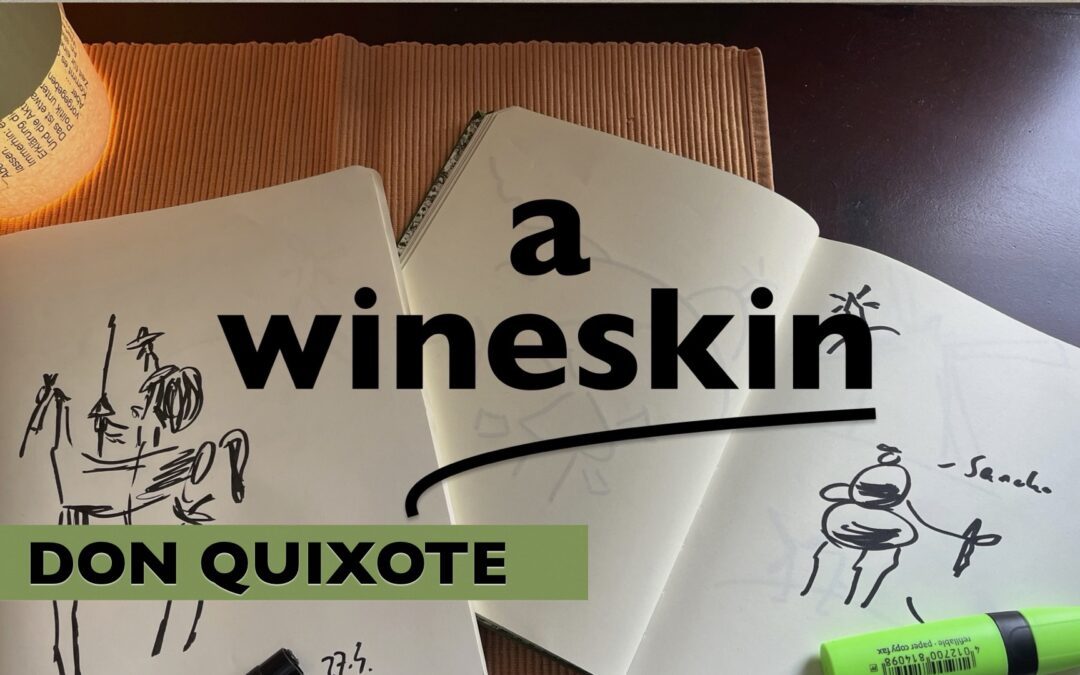
The Knight and the Slashed Wineskin:
A Guide to Beautifully Wonky Friendships
What actually makes me get up from the sofa, dust off my laptop, and start writing?
Dialogue. Especially the wonky kind.
Picture this: two people chatting. One is perched high on a horse; the other is riding right next to him on a donkey. It is the perfect visual. Today, I want to talk about Don Quixote.
About ten years ago, I was going through a seriously rough patch. During that time, this book became a true friend to me. Because at its absolute core, this massive, legendary novel is really just a story about friendship. I want to share that experience with you today.
Slashing Giants (or Vineyards)
Let’s travel back to 1605. Miguel de Cervantes publishes a book that gives the world the phrase „tilting at windmills.“ It is packed with countless adventures, but today we are diving into my absolute favorite. Well, to be fair, I have about fifty favorites, but this one is special.
Our duo is hanging out in a tavern. Don Quixote is convinced he has just slain a terrifying giant. Sancho Panza, ever the realist, tries to point out that it was actually just a wineskin. To make things more wonderfully chaotic, there is a lady there named Dorothea. She is pretending to be a princess, and she belongs to a whole group of people who just go along with whatever wild thing Don Quixote says.
Let’s linger here for a moment and look at the dialogue:
Sancho: „Sleep on, Sir Knight of the sad face, and sleep as long as you please. No need to trouble yourself about killing giants, for it is all over now.“
Don Quixote: „I should think so indeed. For I have fought such a mighty battle with that giant as I never expect to fight again. With one sweep of my sword—swish!—I struck off his head, and so much blood poured from him like water after a storm.“
Sancho: „Red wine, sir, would be the better word. For the dead giant, if you must know, was a slashed wineskin. And that blood was several gallons of good red wine from its belly.“
Negotiating Reality
They are constantly negotiating reality, and the gap between their two worlds is not a small one. Are they burning bridges here? Let’s read a bit further into their conversation:
Sancho: „Get up, sir, and take a look at the fine work you’ve done. And you’ll discover that the princess has turned back into a lady named Dorothea, along with several other marvels that may surprise you, should you care to understand them.“
Don Quixote: „None of that surprises me in the least. If thou remember, I told thee the last time that everything in this place was touched by enchantment. It would be no wonder if it were the same now.“
Sancho: „I might believe that, if my own tossing in a blanket belonged to the same enchantment. But it did not. That was real enough… I cannot see any enchantment in it—only bruises and bad luck.“
Don Quixote: „Well, well. God will give a remedy. Hand me my clothes and I’ll take a look at these transformations you’re talking about.“
Something incredible is at work here. But what is it?
Sancho loves his red wine. He is an earthy, practical guy, and he knows his master is talking absolute nonsense. So, why does he stay? It is fascinating to look at.
The way I see it, it comes down to three things:
The energy of the journey: There is a constant forward motion. So, on they go.
The promise: Don Quixote promised Sancho he would make him the governor of an island, which is definitely a soft spot for Sancho.
Friendship: By Chapter 37, they have built a deep camaraderie. They keep completely misunderstanding each other, but the relationship keeps working. It is incredibly touching. The very foundation of their friendship is built on their misunderstandings—their completely asymmetric, beautifully wonky perceptions of the world.
The Cervantes Style
Let’s linger one more time on the essence of this, because it is so close to my heart. Look at this brief version of their exchange:
Sancho: „Just get up and see what a fine job you’ve done.“
Don Quixote: „All right, I’ll take a look at these transformations you’re talking about.“
That last line from Don Quixote is like a three-layer sandwich:
Tenderness: It shows the deep warmth of their friendship.
Curiosity: He has the pure, childlike curiosity to discover the world.
Irony: This is the signature Cervantes style.
It is not the kind of irony you find in today’s world—which is often cold, distant, and detached, like a comment section on social media. This irony is a different animal. It wraps itself lovingly around everything. The essence of Cervantes‘ style is an irony that welcomes everything, embraces the ordinary, and holds space for the ambiguous. It is an irony with an embracing touch.
There is always something in it that I can’t quite put my finger on. It leaves me searching and forces me to stay curious, wanting to discover the world just like Don Quixote. When I read this book while sitting relaxed on my sofa, I feel a deep sense of comfort, reassurance, and confidence. All of that comes from this beautiful book.
If you enjoyed this read, and if you know someone who spends a little too much time on their own, please share this with them. It is important to remember: books can save lives.
Neueste Kommentare